
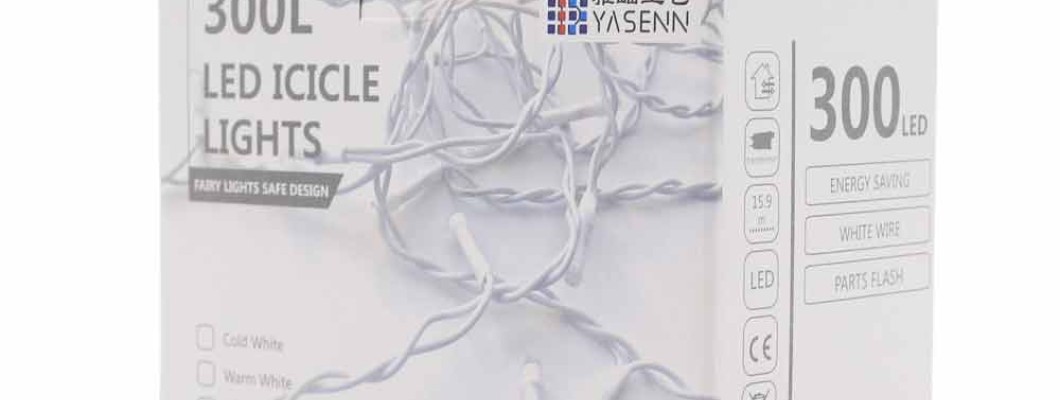

You can buy two identical strings of Christmas lights - same LED count, same wire, same price - and the only difference between them is a number you have probably never seen on a spec sheet: color temperature, measured in Kelvin. Yet that single number is the one that changes how your house actually looks to every visitor walking past. This is the part of Christmas light buying that most guides skip, and it is the one that makes the biggest visual difference of all.
What 2700K and 5000K Actually Mean
Color temperature is a leftover from physics: it describes the color of light produced by a black body at a given temperature. In practice for LEDs it is simply a scale. Warm white sits around 2700K-3000K - it has a soft yellow-amber cast, similar to a candle or an old incandescent bulb. Cool white sits around 5000K-6500K - it reads as a crisp, slightly bluish white, similar to midday sunlight or office lighting. Anything between (3500K-4500K, "natural white") is a compromise that few Christmas light strings actually ship.
The reason the scale runs the way it does: hot objects glow blue-white, cool objects glow red-orange. Your eye has learned the mapping over a lifetime, so even though an LED produces neither temperature nor heat, the number still carries the same emotional weight. Warm reads "cozy, evening, home." Cool reads "clinical, daytime, store."
Why Warm White Wins on Most Houses
Three reasons, all about the surroundings:
1. It matches what you are lighting. Christmas decoration - pine green, red ribbon, brown wood, brass fixtures - is all warm-toned. Warm white light reinforces those tones and makes greenery look fuller and red look richer. Cool white light pushes the same surfaces toward gray-blue, which is exactly the "plastic" look people complain about in photos of badly decorated houses.
2. It matches the environment. In December evenings, the competing light sources are street lamps, shop windows and neighbors' strings - almost all warm. A cool-white house stands out against the street, but not in a festive way: it looks like the house is lit by its own fluorescent tube. Warm white blends into the street scene and is read as "decorated" rather than "lit up."
3. It photographs better. Phone cameras in low light push everything warmer anyway. Warm white lights therefore render as a clean, golden white in photos and videos - which matters more than ever, because most of your neighbors' Christmas displays are now first seen in social media, not in person.
The Three Cases Where Cool White Is the Right Call
Cool white is not wrong - it is just a different job. It works when:
1. The building facade is modern and monochrome. White-rendered or glass-fronted buildings can look sharp with 5000K lighting, because there is no warm wood or brick fighting the color. This is a commercial-signage look, and it works on facades, not on trees.
2. You are competing for contrast, not atmosphere. In a street where every house is warm white, a cool-white outline can read as "different" - which is sometimes the point for a business storefront.
3. The lights are functional, not decorative. Walkway illumination, security lighting along a fence, or work-area lighting benefits from the higher color temperature because cool white gives better color discrimination and a sense of alertness. That is a utility job, and 5000K does it better.
Practical Buying Rules
If you are mixing strings on one property, pick one white point and stick to it - warm white for the tree, roofline and shrubs; cool white only if you have a deliberate reason. Mixing 2700K and 5000K strings on the same roofline is the single most common mistake we see: from the street it looks like two different brands, because to the human eye the two whites are nearly as different as red and blue.
Two more checks before you buy: ask for the Kelvin value in writing (a spec that only says "white" is a coin flip), and if you are buying several strings for the same area, buy them from the same production batch - even within one Kelvin rating, small batch-to-batch variation is visible when strings hang side by side.
And remember: the same physics applies to the candles. If your Christmas table has warm-white lights, pair it with warm candlelight; a cool-white room with candle-warm accents looks inconsistent, not layered.
Leave a Comment